Showing posts with label Japanese. Show all posts

Thursday, 28 April 2011

Supra nova - the new Georgian cuisine


Fusion cuisine gets a lot of bad press these days. In some restaurants, the very word ‘fusion’ is about as welcome as the words ‘rat droppings’ and ‘AA Gill’. It is a little hackneyed, I suppose. After all, you have to go back to the 1970s - when chefs mixed French with Chinese and came up with twisted classics like bird’s nest bouillon and coq au rice wine (maybe) - to realise fusion cuisine’s potential for pretentiousness and horror.

Nevertheless, most countries go through their fusion phase, melding their traditional wares with ingredients and techniques from whichever foreign cuisine seems to be en vogue at the time - which usually means Japanese (*whisper* I’m convinced the only thing that prevented Nobu from giving his food a Japanese twist rather than a South American one was the fact that it was already Japanese). 


Anyway, now it’s Georgia’s turn. That’s Georgia the country - in Europe - not the American home of Coca Cola and REM, and nowt to do with Ray Charles, either. 

Traditional Georgian food is typified by the ‘supra’ or special feast, which is presided over by a tamada or toast master, and involves a huge table strewn with a multitude of brilliant dishes, from kachapuri breads and shashlik kebabs, to khinkali (heavy dumplings stuffed with ground meat) and nigvziani badrijani (aubergine stuffed with ground walnuts). As feasts go, it’s a real heavyweight.


A traditional supra: note the celebratory hats, and goat skin wine bag.

This is probably the bit where most hardened and cynical restaurant-goers will recoil in terror, recalling such fusion faux pas as ‘tandushi‘ (tandoori sushi, seen in Abu Dhabi) and ‘sashimikraut’, and foreseeing a culinary train full of cheap Taiwanese fireworks crashing into a nuclear power station. But you should keep on reading, because here is a rare example of fusion that really, really works. 

It’s by a talented female chef called Tekuna Gachechiladze, and I was privileged enough to try it at Vong, an Asian restaurant in the Georgian capital Tbilisi. I say privileged, because not only were we dining with one or two distinguished members of the Georgian media and political establishment, but it was also the night that the Georgian football team beat Croatia 1-0 in a Euro 2012 qualifier. Oh, and some of the dishes were being served for the very first time. An historic occasion. The mood was buoyant. 

The amuse bouche - a gazpacho of tkemali (a traditional and rather tart cherry plum sauce) with the sweetness of grape to balance it out - set the tone. It was followed by a triumphant tuna tartare with jonjoli (a kind of Georgian pickled flower with a flavour not unlike capers) and rainbow trout ceviche marinated in orange juice. Podgy king prawns in tarragon sauce came next, followed by the night’s first true revelation - the dolma. 


Shrimp dolma.

Stuffed vine leaves are familiar all over the Middle East, Mediterranean and the Caucasus, but not vine leaves stuffed with shrimp, and served with a raita-style yoghurt sauce with mint and ginger - a combination as devastating as Smith & Wesson. 


Ham-wrapped quail in pomegranate sauce.

This was followed by roasted quail wrapped in cured ham, slathered in a thick pomegranate sauce - a rich, smokey-sweet blast of gamey flavour and moist textures. I sucked on about four of these like Kojak after a lollipop shortage, and then things got even more interesting.

The khinkali arrived at the table like Katie Melua dressed in a kimono. Instead of the bulging, tumescent and hearty dumplings of the traditional Georgian supra table, they had been given a Japanese makeover; a twist on the gyoza dumpling, made lighter, more elegant and refined but no less delicious. The time-honoured Georgian flavours flooded the palate, but they didn’t have to fight their way through inches of dumpling dough to do it.        


Badrijani and foie gras.

Let me assure you, if I’d dispatched as many traditional khinkali as I did the new gyoza-style version, I’d have needed two seats on the plane home. And probably a triple heart bypass. But home couldn’t have been further from my mind when the badrijani with foie gras turned up. I must confess to having one or two misgivings about the samey textures and smokey-sweet flavours of the walnut-stuffed aubergine and foie gras. They were unfounded. The combination worked like a dream - a dream with great lobes of perfection-seared enlarged goose liver in it. The only word I could muster at the time to describe its magnificence was “Waaarg.” It was that good.  


Badrijani and foie gras - again.

I’d been taught a lesson about fusion cuisine. It may be a jaded concept in the trendy restaurants of New York or London, where nobody wants to gatecrash a party right at the end. But in Georgia, fusion is less of a fad and more of a process. Traditional Georgian food in itself is fusion food, after all - were it not for the Mongolians there might not be khinkali at all; and the Ottoman Empire may have something to do with Georgian dolma. Conversely, the rest of the world might have a debt to pay to ancient Georgian viticulture - thought to be over 7000 years old - for inventing wine as we know it. 

Tekuna Gachechiladze plans to open a New Georgian restaurant in Tbilisi and, in the future, New York (personally, I think ‘Supra Nova’ would be a great name for it and I’m not asking for payment, just a shedload of badrijani with foie gras). There she might just mash up those stuffy preconceptions about fusion food and serve them back up with a nice ponzu sauce. But in the Georgian food story, her inspired ideas are merely the latest chapter. Just forgive me for revelling in the prose before I turn over the page. 

Monday, 20 December 2010

Tsukiji Fish Market, Tokyo - the eighth wonder of the world


Welcome to Tsukiji, the world's greatest fish market. Although market is probably the wrong word - this place is nothing short of a wonder (next to Tsukiji, Machu Picchu is a mound of bricks on a hill, etc). 


The 57 acre site is a city of seafood, where over 2,000 tonnes of the stuff is displayed and shifted each day - that's over 700,000 tonnes a year across more than 1,500 stalls. Over 60,000 people call Tsukiji their place of work, and very few of them can ever claim to have a dull day. 


That's because Tsukiji is an explosion of vivid colour, clattering sound and heady ocean scents that grabs all of your senses at once, shakes them up in a giant conch shell, tips them into a polystyrene box full of ice and sells them to a sushi chef. 


Pull on some shoes that you no longer love, and come wade through the fish guts, as we tour the myriad bonkers sights of Tsukiji.


Baby squid taking a nice bath with some ice cubes and some black ink.


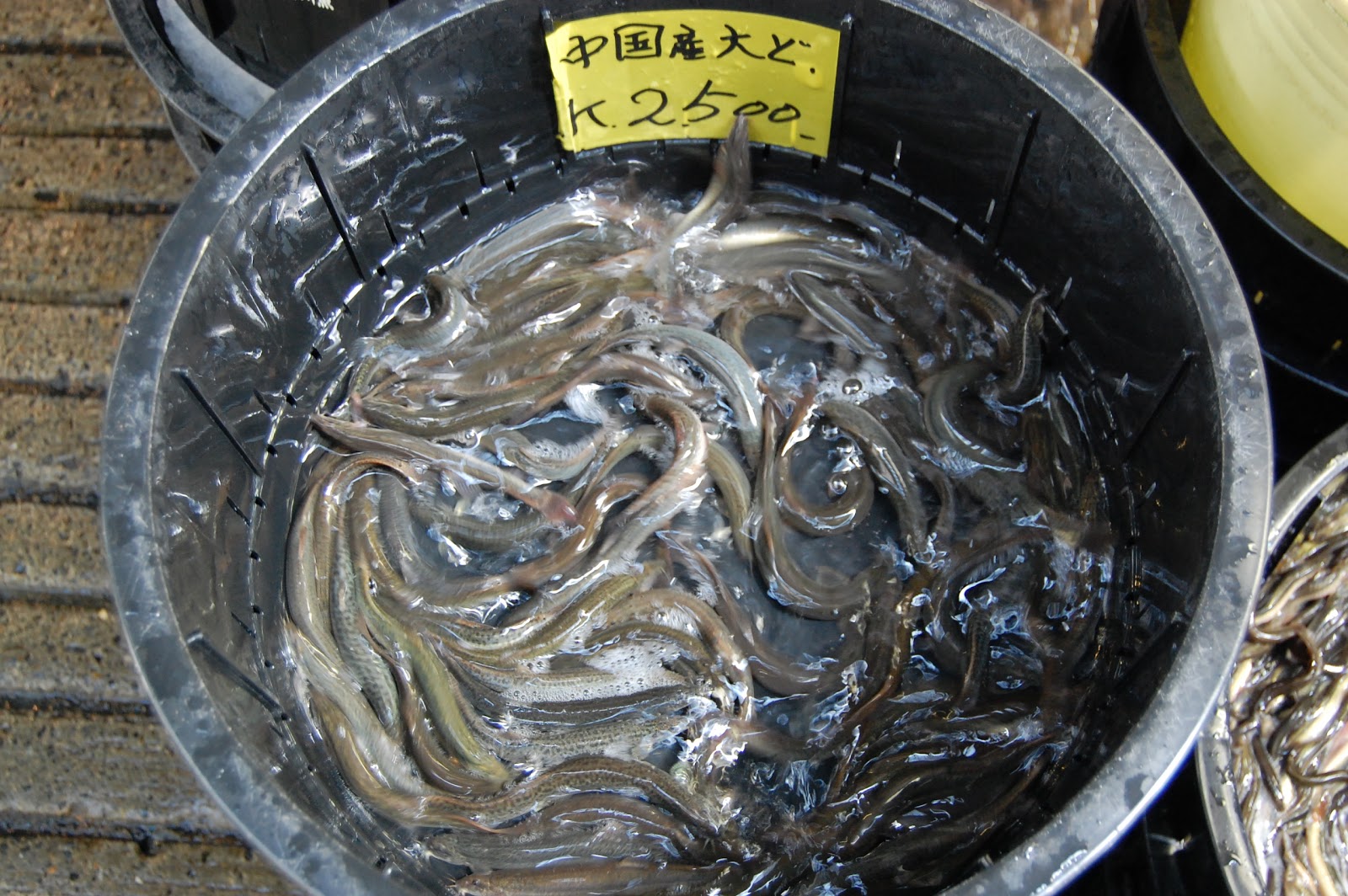
Eels do it in blood-sullied water.


 Huge octopi brazenly showing off their tentacles.


More cephalopods than you can shake a squid at.


When the going gets weird, the 'geoduck' turns pro.


The Tsukiji barbershop singing troupe turns up for morning practice. 


'Salmon in a box' doesn't quite do this pic justice, does it?


"I'm sure I left a white polystyrene box around here somewhere."


Pfffft...your guess is as good as mine.


"Hey, I can see your brain from here."


For the life of them, Toshiro and Dave couldn't work out where the fishy smell was coming from.


There's nothing better than a bucket of eels, is there?


"One day I'm gonna get me an R2D2 unit like Haruki's."


Three men, an ancient looking cart, and a ready-made photo opportunity.


"Mom, which knife should I use to disembowel the nosey Englishman?"


Don't you just hate it when a prawn burrows into your neck?


"Aren't you glad you're not us?"


If you don't want to know what they did with this blood-soaked chopping board, razor-sharp knife and bit of bent coat hanger, don't look below.


It's a cruel world ain't it?

Wednesday, 9 June 2010

Pot Noodle World Cup - part 3


Lucky Me - Bulalo
Philippines
(sachets - 3 + plastic fork)


As if to remind you that Filipino food is a bit, well, crackers, there’s a sachet of crackers included with this nest of noodles. You also get sachets of ‘beef’ soya bits and an indeterminate variety of flavouring powder, which, when everything comes together, re-creates the Filipino classic Bulalo - kind of. Everybody knows that crackers and soup go together like rump steak and chewing gum, and what any good bulalo really needs is a huge bone or two, stuffed with soft, juicy marrow. Taking the bone out of bulalo is like removing the karaoke machine from a Filipino funeral wake - leaving the whole thing flat, disappointing and as lifeless as the chick in a balut egg.

4/10 - Potty.


Koka - Laksa
Singapore
(sachets - 4 + plastic fork)


Having a pot noodle in your cupboard is like having a spree-killer your family - you’d prefer not to admit it at dinner parties. But when a minor lunchtime crisis strikes - or some kind of nuclear conflict happens - you could do much worse than this. There’s everything you need here to survive armageddon for at least a couple of hours - from the 4 sachets (seasoning, chilli oil, dried veg and coconut powder, in case you were wondering) you can use the plastic to fashion some kind of radiation-proof hat; and the pleasant, creamy and soupy noodles will keep you occupied for at least 12 minutes prior to that. In peacetime however, it’ll just make you long for real laksa, and leave you feeling slightly empty inside. 

6.5/10 - Laksa little something. Ha-har - I’m here all week, folks!


Nissin
Japan
(sachets - 2)


You know what they say about the Japanese - the Pot Noodles they eat today are the Pot Noodles the rest of the world will be eating in 2078. Discovering this impressive melange of futuristic ingredients is like a trip in a DeLorean fixed with a flux capacitor. The plastic lid snaps off to reveal a sachet-fetishist’s wildest dream. Even the noodles come in a sachet, and guess what - they’re wet. Where most noodle-cakes resemble a tramp’s urinal-dampened shoelaces dried out on a radiator, these are moist, thick, bouncy udon noodles. There’s a sachet of miso-style powder with dried seaweed bits and then the coup de grace that buries all other pot noodles in a kettle-shaped coffin marked “fail” - a sachet containing a whole, flat, dried tempura cake, packed with fishy flavourings and prawn bits. By the time the rest of the world are eating these noodles, the Japanese will have done away with food altogether and replaced it with sound waves or dehydrated trousers.  

12/10 - Pot of gold.


Pot Noodle World Cup winners 2010 - Japan

Tuesday, 23 February 2010

Black cod, bluefin & Greenpeace: Nobu speaks

Love him or loathe him, it’s difficult to imagine what the world would be like without Nobu Matsuhisa.


There’d be a lot more black cod in the sea, that’s for sure. The ‘contemporary Japanese’ phenomenon probably wouldn’t have happened, so Dubai would only have about six restaurants. Former tennis star Boris Becker might not have got up to a certain act in a certain broom cupboard. And Robert De Niro may well have gone into business with Ainsley Harriott instead, which really doesn’t bear thinking about.


Well, Nobu is here, and at the end of last year he was here in Dubai. I caught up with him at his restaurant in The Atlantis just over a year after its launch, to ask him about his impressions of Dubai, his restaurant here and its signature dishes. But the interview took an interesting turn as we discussed his imitators and the controversy surrounding his refusal to remove the endangered bluefin tuna from his menu.


Parts of this interview were used in Esquire magazine in the Middle East, but in this two-part blog post (I know you love the suspense) here’s the rest in all its glory... 


(part one)


JB: How’s Nobu Dubai coming along?


NM: We just passed one year, and it’s much, much more comfortable than in the beginning - maybe in the last six months. The quality is higher and the people know how to work now, the organisation is stronger.


Has it exceeded expectations?


I knew it would happen like this. When I come here and people are working, they are very comfortable and smiling. When you’re comfortable in the kitchen you want to try something more challenging. So this kind of energy makes everybody happy, there’s a happy feeling at this time.


How is Dubai different?


It’s the religion here. I was a little confused at the beginning. We cannot use soy sauce with alcohol because of the religion. But now we know how to do it. Alcohol is the difference. And costumes. In the west people wear suits but not here. And sometimes husbands and wives have to sit at different tables. I don’t know why, but... It’s this kind of thing that’s different from New York or any other country.


It’s the culture. I learn from the culture. There’s nothing strange about doing something different. There are a lot of beautiful people here. People come to dress up. Americans come in t-shirts and jeans, but mostly at nighttime here they dress up. 


You create your own dishes for the menu, but tell me about your Dubai chef’s own creations...


Herve, our chef here, used to work at Nobu Paris, so already he knows the basic Nobu menus. He loves cooking - he’s French -  and he shows me his creations, we discuss them and finally we made like three or four dishes. I don’t want to say to the chef, ‘you must make exactly this,’ because chefs have a lot of creativity. We are not KFC or McDonald’s restaurants. We have recipes, but the chef has a lot of opportunity to make his creations, but basically we have the sauce, flavours, style...


So it’s like a guideline?


Yeah. I don’t want to say, ‘don’t do this’. Try as much as possible. Food is like fashion. Fashion changes - the style, the quality, the colour - it changes every year. Also, it depends  on the country too. New York and London are very fashionable, that’s why there’s always more competition. Dubai has a different style of fashion, but Nobu is still new here - one year. Still we have to teach the basic signature dishes to our kitchen staff. But a lot of people coming here know the other restaurants - New York, Canada... no not Canada (laughs). I confuse myself!


You say food is like fashion, what about the competition that comes with it? I’m thinking about places like Zuma and Mirai.


In Zuma, it’s the guy who used to work for Nobu Tokyo, he moved here. Of course, he knows my style. Then there’s Scott (Hallsworth) at Mirai. I don’t know when he moved here, but he was with me in London and Melbourne. So, automatically they know Nobu’s food. Then they open their restaurants here and they know the most popular dishes. I don’t want to say that they copy everything from me, but it’s like in fashion - somebody is copying, then little by little he makes something original. I am very proud because people understand and accept my food and it’s popular. I’m very proud that my dishes are popular in the world.


Have you been there - Zuma, Mirai?


I went to Zuma once - just for a drink. I have no time, too busy (laughs).


Why do you think this type of contemporary Japanese restaurant is so popular?


I don’t want to call it contemporary. Its background is Japanese, but it has a Nobu style. It means that we have a lot of choice on the menu - we have raw fish, shellfish, meat, lamb chop, quail, vegetable, noodle. Customers choose a lot of varieties. But some Japanese restaurants are very traditional. The service is very traditional. Here people choose the atmosphere, the energy, the good food and good service. The background is Japanese but the difference is in the service, style and hospitality. Customers have to enjoy their time in the restaurant because they are spending money. So this is Nobu’s philosophy, I guess. I enjoy to see customers eating, smiling, laughing. 


Nobu restaurants have been going for more than 20 years, so this is my style. For an example, if I go to a French restaurant with Michelin stars, it’s very quiet but beautiful presentation and the service is very formal. Just me - I don’t enjoy much this kind of restaurant. I enjoy restaurants that are more casual, but service is perfect. Food can be eaten with chopsticks or a knife and fork. It has to be comfortable. This is Nobu’s concept. When a customer comes in, we say ‘Irashaimase’, which in Japanese means ‘welcome’. Many people don’t understand. They ask what it means, and we say, as a joke, ‘spend money!’ Jokes make people comfortable. At Nobu people are comfortable - in New York, London and other restaurants - because it’s the same feeling. Immediately they know it’s a Nobu. The good food, the service, the communication. Traditionally, at French Michelin restaurants they never talk or say ‘hi, how are you doing?’. It’s tight silence.


About Nobu’s small portions, are they popular in the Middle East because they are like mezze?


It makes sense. We have a lot of varieties and if five or ten people sit down, we do it sharing style. Not individual plates. You can order a lot of different things, do a lot of tasting. Maybe this is one of the reasons?


Tell me about black cod miso and the many versions of the dish outside of Nobu?


I have the black cod in this restaurant.


Obviously! Do you mind that they do it elsewhere - Zuma, Okku...? Have you tried it?


No. I’m very proud because I started black cod more than thirty years ago. In the beginning nobody used it, it was very cheap to fish. Now the price is up. All the restaurants in five continents use black cod. Best seller - number one.


What do you think about everybody using the recipe?


I’m very proud. It’s nothing to feel bad about because it’s a good image. People talk about black cod and they know it’s Nobu’s signature dish. Even Zuma makes black cod - oh, this is a Nobu dish (laughs). 


It’s like free advertising...


One time in the London newspapers they said that Robert De Niro is the Godfather, but Nobu is the Codfather! (eruptions of laughter).


To be continued...