Wednesday, 27 June 2012

The Lost Interviews, No. 3: Michel Roux


Another lost interview from 2008...

Michel Roux is one of the godfathers of the modern British food scene. Along with his older brother, Albert Roux, the Frenchman is credited with transforming the culinary landscape in London, first with Le Gavroche and later with The Waterside Inn, in Bray. On the eve of his appearance at the Jumeirah Festival of Taste, he spoke to James Brennan about Dubai’s restaurants, Britain’s knife culture and the cult of the celebrity chef. 

You became the first restaurant owner in Britain to gain three Michelin stars, how important is Michelin to chefs?

Well the Michelin is not only a guide but the most well established, and longest established guide in the world. It used to be just Europe, but now it’s covering America in two parts, Japan and Hong Kong soon. The three-star Michelin winners are a bunch of a few people who are the creatives, the leaders and the best places to eat in the world - without any doubt. So it is important because it’s wonderful to be recognised as one of the best. The best? Certainly not, but amongst the best. 

Do you think Michelin will come to Dubai?

I don’t know. I can’t speak on behalf of Michelin. I will say one thing, and I know this by experience, that each time I come to Dubai - and I’ve been at least three or four times - I see a tremendous evolution. Certainly it is one of the cities in the world now where there is no fear of not standing up on what I cal excellencies. There is a choice of every kind of food, from ethnic food to classic French and Italian. You have the top name chefs cooking there. The front of house, the service, is immaculate in most of the places. And they certainly have reached the top cities of the world. Would Michelin go to Dubai? I don’t know, I’m not Michelin, but if Dubai can carry on the way they have been progressing over the last five years, I would say there is a great possibility that this can happen.

How does it compare to London or Paris at the moment?

I wouldn’t make any comparison of that, because it is still newly established. You’ve got places in London and Paris who have been at the top for thirty years or more. It’s not a fair comparison. I’ll just say I’ve got no problem with eating very good or excellent food in Dubai, and I know quite a few places - I’m not saying hundreds - but tens and tens of places where you can have superb food. 

You helped to revolutionise the food scene in England, but you recently announced that you were leaving London for Switzerland, why is that?

Simply because I’m 67, and I decided three years ago. The press were late to pick that up. I bought a place in Switzerland which I love because it’s in the mountains. I love the peacefulness, the calmness and the safety of Switzerland. I’m not attracted anymore by a big city - especially in the UK - where you’ve got dodgy young people, hooligans and dangerous people. When you see that 20 young people have been killed in London by knives in one year, it’s frightening. I can’t take the train at night after 11 o’clock or midnight to go to the country from London. So what is the pleasure of living in a country like that? I prefer to go to the mountains, I prefer to go to Geneva and enjoy my life peacefully. When I came to the UK 40 years ago, it was a country I respected and loved. Now I’ve got to look over my shoulder, and I don’t feel like I should have to do that - not at my age.   

Dubai is safe, you could always move there and start another food revolution...

(Laughs) I know that, but I’ve come to the point as well that I like to give my service to prestigious places in the world, I do like as well to give demonstrations, master classes and give lectures in colleges to help young people to develop further. But I don’t want too much heavy burdens. I’ve got no wish of starting and building a restaurant. Doing a consultancy, guiding people, providing my advice - yes, I will. 

Tell me about the Roux Scholarship.

It was started 26 years ago to help people to further their education, and be able - if they win the scholarship - to have an open door in any three-star Michelin (restaurant) of their choice in Europe. And that is unique - all paid for, for three months, by the Roux Scholarship. We give them a crash course in language. So the current one is with Santamaria - who is at the Atlantis, at the moment - he learnt Spanish and a bit of Catalan as well, to be able to grasp and understand the language. 

Who is the best chef that you ever trained?

Very difficult to say, I’d say, most probably Pierre Koffman (of La Tante Claire, now Koffmann's London). He was certainly one of the best chefs we ever trained. There have been quite a few others, but if I’m going to single out one then it would be Pierre Koffman. 

What is the best advice you can give to a young chef?

To learn as much as they can. Not to look at what they earn today, because what they earn today is not what matters. What’s important is what you learn - what you acquire, knowledge and experience, which will give you the possibility of reaching the highest position later on in your life. And not to try to be someone else but be yourself, because there is nothing worse than people trying to do something when they don’t feel at ease in their own skin. You must learn at least a good ten years before you can say you’re a sous chef, a good fifteen years before you say you’re a chef - a proper chef.    

What do you think about today’s cult of the celebrity chef?

Not very much. But it is the media who have created that, and they are very thirsty, those kind of guys. They make cheap programmes, if you look at it. And the BBC, who used to be one of the best television (stations) in the world forty years ago up to at least twenty years ago, giving some very good programmes, entertaining, educational shows, drama, was an example for the world. It’s garbage now. Twenty or thirty percent of programmes on the BBC, I switch on then switch off immediately. And quite a few of them are on food matters - at seven, eight or nine in the evening. Who wants that? You should be cooking or eating with your family. Not eating packets of food, and garbage, watching the television. I’m not against celebrity I would just say it’s gone too far. Too far means there is too many of those young kids, or people or chefs on television who are doing things they either don’t know or they are asked to do to entertain the public. We are not in the business of entertaining. Cooking is for enjoying food, eating, and it’s for the palate. 

Do you think many young people have ambitions to become celebrity chefs instead of good cooks?

They go into it for the wrong reasons surely. They’ve got the example of the young stars, so-called stars, who obviously make millions from their products, and they’re 25-35. So they want to be a cook - and the parents do. They say “be a chef, be a Jamie!” Well, well! And big supermarkets take those people on board because they’ve got the right image. But I think we’ll come back to basics, with what’s happening in the world, by the way. I think people will have to can the beans, and go back to what we called sanity. We’ve gone too far in many, many ways. And that’s one of them, by the way. Enough mockery of our profession. Let’s be serious, let’s think about our clients in our restaurants. Let’s think about what we buy, the products, how we prepared them the best way and how we serve it to our clients. Then we can be proud of our profession again. 

Friday, 1 June 2012

The Lost Interviews, No.2: Ainsley Harriott


Another 'forgotten interview' from 2008...


Ainsley Harriott

The television personality and chef Ainsley Harriott has made a career out of the lighter side of food. As well as helping people to learn how to cook, his shows are all about relaxing and having fun. But his participation in a recent BBC documentary about genealogy forced him to face up to some uncomfortable truths about his family’s past. He spoke to James Brennan about the experience, his career and his critics.  

Tell us about your involvement with the festival of Taste.

I’m coming down there to do several food demonstrations, hang out with the chefs, and get people involved with food a little bit more. I think that’s what food festivals are all about. Just remind them that there are lots of dishes that are accessible. Sometimes these things can be a little bit far-fetched - people think “oh my god, unless I’ve got a certain type of stove, unless I’m making a reduction here and doing this there...” They feel like they can’t do it. My philosophy has always been accessible food - food that people want to cook. And at the same time trying to incorporate a bit of fun into the show. People can relax and have a go. They don’t go into their kitchens feeling tense.

Do you see yourself more as a performer or as a chef?

I think both. I’ve just done the programme Who Do You Think You Are, which traces your family history. On my mother’s side, my grandfather cooked at the White House, he was a fabulous chef. My mum always cooked and always encouraged us to cook, hence me being a chef and my brother being the main cook at home, and my sister is a cookery teacher in her school, so we all felt very comfortable in the kitchen. And yet my dad ended up as this incredible international performer, a pianist that performed all over the world. So I think I combine the two. I like to see myself as a cook with an entertaining slant, which is slightly different from the other guys. 

You uncovered some uncomfortable truths about your family history. How did that experience affect your life?

I think it grounded me more than I was before, and I’m a pretty solid guy. If you look at a tree, it grows and becomes more grand when the roots are embedded. And with a programme like that you discover all about your roots, and what your make up is. Why am I like this caring person? There were teachers, a policeman... My grandfather went out and started the first school in Sierra Leone. There were seven kids and now the same school has 700 kids.

That’s very positive, but there was also the negative side with links to the slave trade...

I don’t think that’s too negative. That’s part of our history. There was something like 300 years of slavery in the Caribbean, so it’s inevitable that when you start researching it you’re going to come up against it. What I didn’t expect was - even though I’d seen pictures of my great grandfather Ebeneezer, he looked like my children - the mixed race look. But I discovered that his father James Gordon Harriott was white. And there was an another generation of Harriotts that came from Scotland in the early 1700s - so I’m Scottish, but I’m not going to be wearing a kilt! And I don’t think you’ve got a sporran big enough for me out there in Dubai (laughs)!

People like Gordon Ramsay are less than complimentary about celebrity chefs like you. What would you say to people like that?

Well, it takes everybody. A lot of people go for the serious angle because, ultimately, that’s what it’s all about. But it doesn’t necessarily mean that’s the only way of cooking. When you look at people cooking in Britain - and Dubai too - they’re not that adventurous, they need to be encouraged somehow. And not everybody needs to be shouted at. I went through my training at Westminster College, I worked in some nice hotels and restaurants. I didn’t get those breaks because in those days as a black chef because even though I was really well qualified they didn’t want a black guy fronting their restaurant. And I can understand that. It wasn’t a major thing with me because it wasn’t done in a disgraceful way. But that’s the way it was then. Things have changed because I’ve propelled myself into the media world and I’ve been able to get my style of cooking across with my personality. Not with Gordon’s personality or Jamie’s - all of them great chefs in their own right. In terms of what Gordon does, he just likes to do that. I remember him having a go at Gino D’Acampo about something and Gino got very upset. Gordon said he only did it for the cameras. He was aggressive in his tone and it was refreshing at first, but after a while people become uncomfortable with it. But I’m a warm person and I like people to feel comfortable - if they’re comfortable they’re going to relax and cook and feel good.       

Do you think there will be a time when the public has had enough of celebrity chefs?

No, I don’t ever think that will happen. Unlike DIY or gardening - which are other lifestyle things - food is something that we deal with all of our lives. Two or three meals a day for a lot of people. I don’t think we’re ever going to tire of it. 

Monday, 6 February 2012

The Lost Interviews, No. 1: Jean-Christophe Novelli


In a short series of 'forgotten interviews' that never saw the light of day, here's one from 2008...


Jean-Christophe Novelli

Jean-Christophe makes women swoon, men jealous and everybody hungry. But it hasn’t all been sweetness and light for the French chef and TV personality. He went bankrupt in 1999, losing all of his London restaurants. On the bright side, the same year, he was voted “the world’s fifth most alluring man” by Harpers & Queen magazine. James Brennan spoke to him about his financial meltdown his image and his unfortunate spat with Sunday Times food critic Michael Winner. 

Tell me about the Novelli Academy.

When I lost everything about nine years ago, it took me about a year or two to get back on my feet. And I thought to myself, I’ve been in the trade now for 30 years, and I wanted to be more involved with the trade, with food, but in my own way. So I got the kitchen table from the garden, brought it inside the farm and started inviting people. I did it for my family and my friends - they could come into my kitchen and it was fantastic. But I started from the age of 14 and learnt everything I could for myself - so I thought it was time to pass that on. It became very popular, so I had to get another table. The more I taught them, the more I leant, and I enjoyed that. I used to go to work for 14 hours a day, six days a week, and I said I didn’t want to do that any more.

How did you get into such severe financial trouble in the late 1990s?
I grew very quickly. You see, the secret in business is to make sure you’ve got money when you start the business. But I started with 500 quid. Then I became popular and opened seven (restaurants) in one go on my own. The day I left the kitchen it was a big mistake. I was acting like a chef rather than a businessman - with emotion, and making the wrong decision. Nothing was calm, everything was affected. And I couldn’t cope (laughs)! I learnt - if it had been one or two places, then fine. But it was too much. After that I bought a fourteenth century farmhouse and let people come to my kitchen. And I’m just about to sell the format in Los Angeles.   

How badly will the global economic crisis affect restaurants?
It’s tough, very tough. Nobody knows what’s going on. And especially now people are more involved with food, they can cook. Before, a lot of people could hardly cook an omelette! Now they are miles away - with so much more experience. There’s a different way of surviving, and I think it’s going to be hard, but I don’t know anybody who’s not affected. I know people who are thinking of closing on Mondays, all day, and opening on Tuesday for lunch. But I knew something like this would happen - I don’t have a crystal ball, but I’m very sensitive because of my mistakes. And when there is terrible weather (in the UK) also, it’s awful.

What did you learn from working with Keith Floyd in the ‘80s?
I learnt to interact with people, actually, to come out of your shell. And not to act too intense with your cooking. I learnt his sense of humour. And don’t forget that before I worked with him I was his friend - before I came to the UK. It was a good relationship - in fact, I’m the only one he never sacked! 

Does your heart-throb image ever get in the way of the food?
Ah, I don’t think it does. If it did, do you think I would be able to work like I did all my life? When I was in Paris, I worked every day doing 200-300 covers at lunchtime. And my dream was to come to Great Britain, and then America one day. And I stuck to my dream. I just came back from Los Angeles and I just finished my TV series, which is coming out next year, in February. It’s going to be massive. And that’s why I’m going to start my cookery school over there, to expand it.

You famously barred the food critic Michael Winner from one of your restaurants. Why was this?
To be criticised is one thing, but it has to be constructive. It has to be fair. I don’t like to waste my time with anybody like this. I’d always had time for him and treated him like a customer, but one day there was a picture of this chap in front of one of my establishments saying how bad it was. How would you feel? Frankly, I couldn’t even be bothered to argue with him. Then he came back years later - ha, ha - and I jumped on him. I’d organised photographers outside, and kindly stopped him. It was not for me, it was for the people he had hurt. He tried to demolish my staff and myself. My new receptionist did not organise things when he walked through the door and he went bananas! My restaurant manager was in tears - in fact, he left. He was one of the best.

What do you think of food critics?
I don’t want to blow my own trumpet, but I have been reviewed by hundreds and hundreds of people, food critics, journalists, the lot. And I’d never been criticised like this in my life. I’ve had far more great reviews by people who I have never even met. Journalists come to my restaurant and they give false names. Matthew Fort (food editor for The Guardian)? I thought he was ex-army. I cook for customers, not food critics. Actually, I spoke too long about it - that’s not good. I’ve wasted my time and your time (laughs).

You have restaurants in the UK and more in the pipeline - any lans to expand in Dubai?
I don’t know because the problem I have is my farm, my academy is doing a lot better than I thought. It’s unbelievable. And think there’s something in people coming to your house, your farm, to you. It’s an extraordinary feeling. I love it. But I don’t know - Frankly I have to be very cautious with my time. I have just bought some land in Spain to get my own olive oil. I I’m looking at getting cooking into rehabilitation, for drug addicts, alcoholics, anorexics. Anyone with a problem. I think cooking is great therapy. 

Image 'borrowed' from www.jeanchristophenovelli.com  

Thursday, 28 April 2011

Supra nova - the new Georgian cuisine


Fusion cuisine gets a lot of bad press these days. In some restaurants, the very word ‘fusion’ is about as welcome as the words ‘rat droppings’ and ‘AA Gill’. It is a little hackneyed, I suppose. After all, you have to go back to the 1970s - when chefs mixed French with Chinese and came up with twisted classics like bird’s nest bouillon and coq au rice wine (maybe) - to realise fusion cuisine’s potential for pretentiousness and horror.

Nevertheless, most countries go through their fusion phase, melding their traditional wares with ingredients and techniques from whichever foreign cuisine seems to be en vogue at the time - which usually means Japanese (*whisper* I’m convinced the only thing that prevented Nobu from giving his food a Japanese twist rather than a South American one was the fact that it was already Japanese). 


Anyway, now it’s Georgia’s turn. That’s Georgia the country - in Europe - not the American home of Coca Cola and REM, and nowt to do with Ray Charles, either. 

Traditional Georgian food is typified by the ‘supra’ or special feast, which is presided over by a tamada or toast master, and involves a huge table strewn with a multitude of brilliant dishes, from kachapuri breads and shashlik kebabs, to khinkali (heavy dumplings stuffed with ground meat) and nigvziani badrijani (aubergine stuffed with ground walnuts). As feasts go, it’s a real heavyweight.


A traditional supra: note the celebratory hats, and goat skin wine bag.

This is probably the bit where most hardened and cynical restaurant-goers will recoil in terror, recalling such fusion faux pas as ‘tandushi‘ (tandoori sushi, seen in Abu Dhabi) and ‘sashimikraut’, and foreseeing a culinary train full of cheap Taiwanese fireworks crashing into a nuclear power station. But you should keep on reading, because here is a rare example of fusion that really, really works. 

It’s by a talented female chef called Tekuna Gachechiladze, and I was privileged enough to try it at Vong, an Asian restaurant in the Georgian capital Tbilisi. I say privileged, because not only were we dining with one or two distinguished members of the Georgian media and political establishment, but it was also the night that the Georgian football team beat Croatia 1-0 in a Euro 2012 qualifier. Oh, and some of the dishes were being served for the very first time. An historic occasion. The mood was buoyant. 

The amuse bouche - a gazpacho of tkemali (a traditional and rather tart cherry plum sauce) with the sweetness of grape to balance it out - set the tone. It was followed by a triumphant tuna tartare with jonjoli (a kind of Georgian pickled flower with a flavour not unlike capers) and rainbow trout ceviche marinated in orange juice. Podgy king prawns in tarragon sauce came next, followed by the night’s first true revelation - the dolma. 


Shrimp dolma.

Stuffed vine leaves are familiar all over the Middle East, Mediterranean and the Caucasus, but not vine leaves stuffed with shrimp, and served with a raita-style yoghurt sauce with mint and ginger - a combination as devastating as Smith & Wesson. 


Ham-wrapped quail in pomegranate sauce.

This was followed by roasted quail wrapped in cured ham, slathered in a thick pomegranate sauce - a rich, smokey-sweet blast of gamey flavour and moist textures. I sucked on about four of these like Kojak after a lollipop shortage, and then things got even more interesting.

The khinkali arrived at the table like Katie Melua dressed in a kimono. Instead of the bulging, tumescent and hearty dumplings of the traditional Georgian supra table, they had been given a Japanese makeover; a twist on the gyoza dumpling, made lighter, more elegant and refined but no less delicious. The time-honoured Georgian flavours flooded the palate, but they didn’t have to fight their way through inches of dumpling dough to do it.        


Badrijani and foie gras.

Let me assure you, if I’d dispatched as many traditional khinkali as I did the new gyoza-style version, I’d have needed two seats on the plane home. And probably a triple heart bypass. But home couldn’t have been further from my mind when the badrijani with foie gras turned up. I must confess to having one or two misgivings about the samey textures and smokey-sweet flavours of the walnut-stuffed aubergine and foie gras. They were unfounded. The combination worked like a dream - a dream with great lobes of perfection-seared enlarged goose liver in it. The only word I could muster at the time to describe its magnificence was “Waaarg.” It was that good.  


Badrijani and foie gras - again.

I’d been taught a lesson about fusion cuisine. It may be a jaded concept in the trendy restaurants of New York or London, where nobody wants to gatecrash a party right at the end. But in Georgia, fusion is less of a fad and more of a process. Traditional Georgian food in itself is fusion food, after all - were it not for the Mongolians there might not be khinkali at all; and the Ottoman Empire may have something to do with Georgian dolma. Conversely, the rest of the world might have a debt to pay to ancient Georgian viticulture - thought to be over 7000 years old - for inventing wine as we know it. 

Tekuna Gachechiladze plans to open a New Georgian restaurant in Tbilisi and, in the future, New York (personally, I think ‘Supra Nova’ would be a great name for it and I’m not asking for payment, just a shedload of badrijani with foie gras). There she might just mash up those stuffy preconceptions about fusion food and serve them back up with a nice ponzu sauce. But in the Georgian food story, her inspired ideas are merely the latest chapter. Just forgive me for revelling in the prose before I turn over the page. 

Thursday, 21 April 2011

S. Pellegrino World's 50 Best Restaurants 2011 - Rene Redzepi and Heston Blumental


"I want more children - that's what I really want." Rene Redzepi, April 18th, 2011.

The restaurant world had its napkins flapped by the San Pellegrino World's 50 Best Restaurants awards 2011, on a balmy April evening in London. El Bulli, which is to shut down in July, was out of the running this time, leaving the way clear for Copenhagen's Noma to triumph for the second year running. I caught up with a very relaxed (if a little broody) Rene Redzepi on the 50 Best stage, minutes after the Noma team had celebrated their win by prancing around in viking helmets and swigging champagne from the disgorged horns. Did he think his restaurant would now get a third Michelin star, and did he have any plans to open a second venue? Meanwhile, Heston Blumenthal saw his restaurant The Fat Duck drop two places, down to fifth place, which prompted him to declare: "Molecular gastronomy is the most misunderstood title in food."

Thursday, 17 February 2011

Santi Santamaria


The sad death of Santi Santamaria had me reminiscing about meeting and interviewing the great Catalan chef. It was 2009, he'd just opened Ossiano, the stunning seafood restaurant in Atlantis, The Palm, and I'd been invited to dine with Santi and a number of other guests. The food was as great, as you'd expect, incredible Spanish seafood cooked with heart. Santi was very keen to learn about the restaurants of Dubai, but I'm not sure if he ever had time to explore the places we talked about. Either way, he was a fine host with a genuine passion for food, and in particular, his food.

I interviewed him before dinner. It had been one of those interviews where we forgot the dictaphone was running, and just talked. Of course, Santi didn't speak English, and my Catalan was rusty, so an interpreter was on standby. The bulk of the interview was about molecular gastronomy. Santi was in vociferous opposition to it, and while he respected the work of fellow Catalan chef Ferran Adria, he was a passionate advocate of a more natural style of cooking. 

The excerpt below is nothing if not passionate, but it was also very prescient - the following year, Adria's El Bulli restaurant was knocked off the top spot of the San Pellegrino World's 50 Best Restaurants list by Noma, a restaurant that's dedicated to the use of natural, locally sourced ingredients.  

Take it away, Santi...


“I really think that this style of cooking (molecular gastronomy) will destroy the brains of the people. People who eat this will end up with something like mad cow disease. It’s not honest to take a chemical powder and put it in food that people eat. It’s not a natural ingredient. This is a big mistake. You don’t need chemical gimmicks to make good food. When you eat natural products you really understand what they are, the fish or the vegetables, you understand where they are from and why they have the flavour. 

When somebody asks you what is the best cuisine, you would probably say it’s the cuisine you remember - it’s the one your mother or grandmother made for you. It has a personal connection. But in following molecular gastronomy we will kill all the traditions that our mothers and grandmothers knew. In the future the people’s food of memory will be chemical food. I want to pass my cultural richness onto my sons, and their sons. We can always add creativity in cooking natural ingredients. I am always open to finding new ways of treating and cooking natural products, I’m open to innovation. But I will always respect the natural products.

I’m afraid that molecular gastronomy can go on for generations because there’s a lot of money behind it. Martin Berasategui, the chef from San Sebastian with three Michelin stars, said last week that the magazine (Restaurant Magazine) which named El Bulli the best restaurant in the world is only made by a handful of people. It’s a marketing operation. The people who vote for the moleculars might know that they are not the best, but there is such a marketing pressure behind this that they are not interested to say otherwise. It is very sad that the chefs need a gimmick to make themselves noticed by these people. 

In the past, when chefs acquired three michelin stars, there was a mutual respect between all of them. It was like a professional standard or qualification, like a doctorate. But for some chefs that is not enough. In the past there would be sixty or seventy in Europe. But there were some chefs who said they wanted to be the best of the best. There was a marketing push to name the best of the three-Michelin star chefs. And they created a lobby or pressure group, who are a danger to the real cuisine, because they are saying the best are the moleculars. 

I respect the desire of molecular gastronomes to evoke memories and emotions in food. But I do not respect the method. I’m really against the (Spanish) government, which gives money and subsidises molecular gastronomy. When the government of Spain takes molecular gastronomy and says this is the representative cuisine of Spain, it’s about marketing, money and publicity - from only one way. The government doesn’t represent me, or many other more traditional Spanish chefs. Any cuisine can represent Spain - the traditional, the classic, the modern - but not just one, it is a mix. From my point of view, I am really upset about this. 

In my cuisine, what’s most important is the product and the way it is cooked, the precision, the details. With molecular gastronomy, they substitute the chef for machines. With traditional cooking, a chef invents a dish, he believes in his creation, he cooks it and he puts it on the plate. To make this recipe, you need a chef. With molecular gastronomy you don’t need a chef, you just need someone who puts the powder in a machine, who injects a chemical solution. It’s industrial. It’s like a factory. 

Haute cuisine of the future will not be molecular gastronomy. We will go back to the respect of the products, respect of the fisherman who catches the fish, respect of the farmer who grows the vegetables, respect of the butcher who cuts the meat and so on. In too short a time so many things have happened, and it’s getting out of control. We need to settle things down. It can not go on like this. It’s all about money. What is killing the cuisine is the fact that these chefs are celebrities, and they all want to make it big to get as much money as possible. 

I have respect for the people who create the dishes, who mix this with that to make something new. But after that it becomes a copy of a copy of a copy. It’s always the same - where is the art, where is the creativity? It’s like a musician appearing every night but having the same tape played back. The stage is set, there are fireworks, it all looks very nice, but behind the curtain is a tape machine. It’s always the same. Molecular gastronomy is playback.”

Tuesday, 1 February 2011

Benihana vs. Blogger: a kerfuffle in Kuwait


“Waiter, where's my pie crust?” 
“It’s a soft opening, sir.”

The “Kuwaitgate” restaurant blogger saga has prompted me to say a few words on food bloggers and restaurants. 

In case you didn’t know, a blogger in Kuwait (www.248am.com) wrote a slightly unfavourable review of newly-opened Benihana, the well-known Japanese restaurant chain. The restaurant responded by taking legal action. You might be in favour of the blogger, or even the restaurant, but in my opinion both are at fault to some extent.


Let’s look at it from the blogger’s side first. If a blogger is serious about reviewing restaurants and wants people to take those reviews seriously, he should never review a place that’s just opened (unless invited to do so). Wait at least a month before going in there and letting off your six-shooters.

The reason I say this is because almost every restaurant in the world needs at least a few weeks to get up to speed - just like you probably did in every job you started. 


As someone who’s reviewed restaurants professionally, I have occasionally been sent to a restaurant too soon by an editor. The verdict was always the same - there were teething troubles, it might get better, it might not. It was a pointless exercise.


There was no sense at all in reviewing the place, since it might improve over the coming weeks - or it might even get worse - but the review would remain online for months, perhaps a year, without a clear and definitive judgement. Or with an unfair one.  


Better to give the restaurant a short grace period, then any judgement you make will be based on a restaurant that’s functioning as well as it’s ever likely to.


Newspapers like the New York Times give a restaurant a grace period before reviewing. They’re a reputable outfit, wouldn’t you say? If you want your blog and reviews to be taken seriously, you should perhaps do the same. In the Kuwaiti blogger’s defence, he did state that the restaurant was newly opened. But he carried on regardless.    


You may argue that if a restaurant has opened to the public, and it’s charging full price, then it’s fair game. Perhaps. As someone who’s been to far too many brand new restaurants, I know to avoid a newly opened place for at least a month, whether I’m reviewing it or not. 


You may call for the restaurant to charge a reduced rate if it’s on a ‘soft opening’. Maybe you have a point. In fact that would be a good idea. But remember those first weeks in your job? Did you work for half your salary? So why expect a waiter to do that, or a chef, or a restaurateur? There’s a case to be made for restaurants - especially ones in the Middle East - to train their staff properly, so that they can hit the ground running. I support that. But I’ll be giving any new restaurant a few weeks to get its act together all the same if I’m reviewing it - and especially if I’m paying for it.  


Perhaps it’s a symptom of today’s society: we all want instant gratification, we want everything now. Be smart - resist all temptation to visit a new restaurant in its first month. Leave that to corporate lunchers who can slap it on expenses. 


I think I’ve stressed the point enough.


Which brings us onto the restaurant. Benihana Kuwait might feel aggrieved that a blogger can say nasty things about its food just after it’s opened. But blogging is just the modern-day equivalent of word of mouth - it just shouts louder. Just think what all the other people who dined at Benihana in its opening week thought about its food, and told their friends.

The way to deal with this was not by threatening the blogger, who has a perfect right to say whether his meal was good or not. They should have left a message on the blog, explaining that they weren’t quite up to speed yet, and inviting the blogger back to the restaurant once things were better. The blogger would no doubt have returned, written a much more favourable update, complimented Benihana on its excellent customer service and everybody would have lived happily ever after. Blogs can help restaurants too, you know. 


Instead, Benihana have decided to drag this through the courts and drag its own name into the mire in the process. It will not win itself any friends by doing this. It has already won itself a load of negative publicity, when it could all have been so different. Conversely, the blog has had great publicity out of this. 


It’s an example of disastrous PR. Yet all food bloggers and restaurants can learn from it. 


Benihana should drop their case immediately, say sorry and invite the blogger back to the restaurant for a slap up meal. We all know passions run high in the restaurant world, but it’s time to cool off. In fact I invite them onto this blog - neutral ground - to initiate the peace process. Prove to everybody that - like all restaurants - all it needed was a few weeks to start firing on all cylinders. Then you’d have a happy restaurant, a happy chef, a happy food blogger and a happy social networking community. 


Everyone’s a winner.

Monday, 20 December 2010

Tsukiji Fish Market, Tokyo - the eighth wonder of the world


Welcome to Tsukiji, the world's greatest fish market. Although market is probably the wrong word - this place is nothing short of a wonder (next to Tsukiji, Machu Picchu is a mound of bricks on a hill, etc). 


The 57 acre site is a city of seafood, where over 2,000 tonnes of the stuff is displayed and shifted each day - that's over 700,000 tonnes a year across more than 1,500 stalls. Over 60,000 people call Tsukiji their place of work, and very few of them can ever claim to have a dull day. 


That's because Tsukiji is an explosion of vivid colour, clattering sound and heady ocean scents that grabs all of your senses at once, shakes them up in a giant conch shell, tips them into a polystyrene box full of ice and sells them to a sushi chef. 


Pull on some shoes that you no longer love, and come wade through the fish guts, as we tour the myriad bonkers sights of Tsukiji.


Baby squid taking a nice bath with some ice cubes and some black ink.


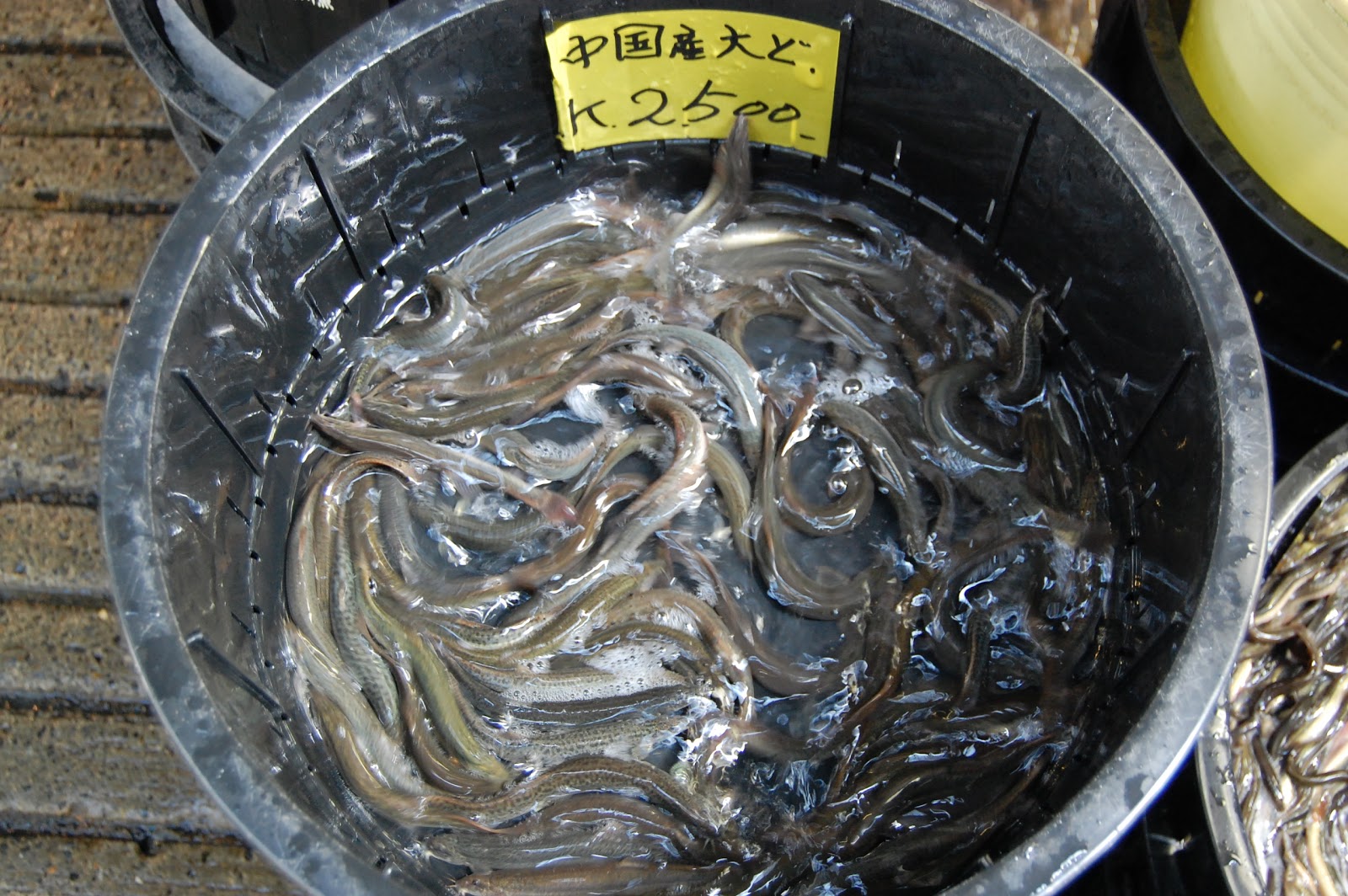
Eels do it in blood-sullied water.


 Huge octopi brazenly showing off their tentacles.


More cephalopods than you can shake a squid at.


When the going gets weird, the 'geoduck' turns pro.


The Tsukiji barbershop singing troupe turns up for morning practice. 


'Salmon in a box' doesn't quite do this pic justice, does it?


"I'm sure I left a white polystyrene box around here somewhere."


Pfffft...your guess is as good as mine.


"Hey, I can see your brain from here."


For the life of them, Toshiro and Dave couldn't work out where the fishy smell was coming from.


There's nothing better than a bucket of eels, is there?


"One day I'm gonna get me an R2D2 unit like Haruki's."


Three men, an ancient looking cart, and a ready-made photo opportunity.


"Mom, which knife should I use to disembowel the nosey Englishman?"


Don't you just hate it when a prawn burrows into your neck?


"Aren't you glad you're not us?"


If you don't want to know what they did with this blood-soaked chopping board, razor-sharp knife and bit of bent coat hanger, don't look below.


It's a cruel world ain't it?

Saturday, 30 October 2010

Gordon Ramsay (in Dubai) - The C-word


No, it's not that C-word, in case you were wondering. But neither is it 'cooking', 'cuisine' or 'caramelised sugar'. It's cars, of course. Because what else would Gordon Ramsay do on his first visit to his Dubai restaurant in two years but screech around the local race-track in a fast sports car? 


The restaurateur, star of The F Word, Hell's Kitchen and Kitchen Nightmares, ex-Glasgow Rangers trialist and occasional cook was in the UAE for a mere 24-hours, in which time he managed to fend off the press, gee up his staff and launch his chef's table concept at Verre by Gordon Ramsay. As a special surprise for Gordon, his team had arranged for him to spend the afternoon driving fast Audis (Audi happens to be one of Ramsay's sponsorship partners, so that was a stroke of luck). "Driving a fast car around a track is a chef's dream," he told me. 


After interviews at the restaurant, esteemed members of Dubai's press, and me, were whisked off to the Autodrome to watch Ramsay go through his paces on the track. I had the dubious honour of accompanying Ramsay in his car as he did his time trial, which obviously gave him a weight advantage. The above video shows what happened...


Thursday, 24 June 2010

Who put the boot into Bhutanese food?


The cuisine of Bhutan was once famously given a right kicking by the ex-New York Times restaurant critic and Gourmet magazine editor Ruth Reichl. She called it the world's worst. So when I recently visited the Land of the Thunder Dragon - the mysterious 'last shangri la' Kingdom hidden in the eastern Himalayas - I was intrigued as to whether the food could actually be as bad as all that. I mean, had Reichl ever eaten Welsh lava bread, Filipino balut eggs (replete with feathery duck embryos) or American plastic cheese by Kraft? 


Above is the first restaurant I set foot in - in the town of Paro, not far from Bhutan's only international airport. Colourful, isn't it? It's got everything a cheerful tourist restaurant might need - bright colours, sturdy wooden tables and chairs, nicely folded napkins, some pretty flowers...

  
...  and a load of car steering wheels stuck on the ceiling. Obviously. They might not be big in the west yet, but steering wheel ceilings are all the rage in the Himalayas. Then I had to wonder whether this was some kind of symbol, a private Bhutanese joke, if you like, about the food served up to whiny foreigners (like Ruth Reichl), and the bend that the locals enjoy driving clueless tourists around with their insipid grub.


Then the food arrived. I must confess, it didn't look like the most inspiring spread I'd ever seen. There was loads of it, but my guide, Tshering, refused to join me in a mouthful. "You first," is what I wanted to say, because if I was going down I at least wanted to take him with me. He grimaced a bit and had a spoonful of plain boiled rice. There was a Chinese-style beef dish, which was as tough as a yak's wellingtons, some plain boiled cauliflower, a dahl soup, and some more Chinese style vegetables. 

I asked him where the ema datshi was, the famous national dish of cheese and red chilli. He explained that it was too hot and spicy for tourists. Since independent travel is forbidden in Bhutan, my guide had worked out my entire itinerary, including the food I was going to eat. I told him to inform the waiters to get busy with the chillies, and in no time a bowl of the famous ema datshi materialised. "You like it," enquired Tshering, with a smirk? "Yhhessss..." I rasped, as my eyes welled up and I reached for the water. Tshering just grinned, and I sensed a steering wheel gently turning overhead. 


Although he seemed pleased that I'd tried to immerse myself in Bhutan's fascinating food culture, I suspected Tshering wanted to punish me in some way for my impudence. I can think of no other reason why, while touring the next day, he asked our driver Jigme to pull over at this roadside stall. Those apples look good, I thought, but Tshering made a beeline for this...


It was dried yak's cheese, merrily hardening in the morning sun. When he handed me a block I thought it was some kind of resilient classroom chalk, or perhaps something used to remove dead skin in the bath. 

  
As this image illustrates, it was indeed hard cheese. The thing had to be bludgeoned heavily with a rock in order to break it up into mouth-sized pieces. "Here, chew it," said Tshering as he lumped a piece into his mouth and began chomping away.

Gah, wouldn't you know it - I'd left my titanium-plated dentures at home. It was like catching a plastic bullet in the mouth. Personally, I didn't know whether to eat it or shoot Maoist insurgents with it. Try as I might, my old fashioned human calcium and enamel teeth could not penetrate the granite-like snack. And since I quite liked having my molars intact (call me soft, but I sometimes like to chew food before I swallow it) I decided to suck the yak's cheese instead, to see if it'd soften up. Half an hour later I spat it out the car window, fully intact, while Tshering wasn't looking.  I think it ricocheted off a rock and killed a peasant.


Lunch that day was far more palatable. It began with a spot of tea - butter tea to be exact (po cha to call it by its local name). It was a curiously savoury drink of warm tea mixed with yak's butter and salt. Quite good, in fact, and just the thing on those cold winter nights several thousand metres above sea level in the Himalayas. Apparently the butter provides sufficient calories for working at such high altitudes, and helps prevent chapped lips in the biting wind. Not all cups of butter tea come with a ghostly apparition of a man's face floating above it - that's a reflection of Choki, founder of the Blue Poppy tour company - Tshering's boss.


Today's lunch selection - in a restaurant in the capital city of Thimphu - was much better. As well as a lip-swellingly hot bowl of ema datshi creamy cheese and red chilli, there was white rice with maize, red rice (which grows at high altitudes), fatty pork and boiled radish or phagsha pa, norsha fin or beef with rice noodles, potato with cheese or keaa datshi, and egg with cheese or eggy cheese. I got stuck in.


So did Choki. Some years ago, he married an English woman. He told me that on his first visit to England, he couldn't get out of the London underground station as he'd never even seen an escalator before, let alone used one. Bhutan only recently got its first mobile phones and satellite TVs.  The capital city Thimphu has no traffic lights.


A few days later, back in Paro, Tshering (above) took me to a farmer's house for lunch. The owner, also called Tshering, said the place was 3-400 years old. It has been owned by his wife's family all that time, but these days it's open for tourist lunches. They even have a couple of rooms available.


Lunch was a simple but surprisingly tasty affair. There was weapons grade ema datshi, beef, potatoes, white rice and asparagus sauteed in butter.


As I ate with a wooden spoon, Tshering translated the farmer's tales of 'night hunting' when he was a teenage lad. This didn't involve shooting yaks after sundown, but climbing up the runged windows of farm houses to look for young girls. If there was one inside, he would hop in and get saucy - all while the parents 'slept' in the same room.


He even showed me the worn rung on the window, used for over three hundred years of the bizarre and very Bhutanese courting ritual of night hunting.


There he is, now a humble farmer and a capable cook, but once a night hunter. I could tell he was getting nostalgic and starry eyed while he was talking about his teenage exploits. But I never expected this...

 
He grabbed a handful of leftover boiled rice and began nimbly fashioning a strange object in his hands. He seemed very adept at making his model, squeezing and folding. Looked like he'd had plenty of practice...


And then this. Yep, it is what you think it is. A little on the modest side, I'll grant you that, but still not a bad representation of a Bhutanese John Henry Thomas. Needless to stay at this stage, it looked a little less likely that I'd take the room.


I thought perhaps the above bottle of Jack and the half empty bottle of Chivas Regal might have had something to do with Farmer Tshering's impromptu handicraft session, but no. Apparently the phallus is a good luck symbol offered to travellers. I said I needed a bit of luck, as my football team Aston Villa were playing Chelsea later that night. 


We got shafted 7-1.


Like the food in Bhutan, my luck in this fascinating Himalayan Kingdom was hit and miss.