Monday, 20 December 2010

Tsukiji Fish Market, Tokyo - the eighth wonder of the world


Welcome to Tsukiji, the world's greatest fish market. Although market is probably the wrong word - this place is nothing short of a wonder (next to Tsukiji, Machu Picchu is a mound of bricks on a hill, etc). 


The 57 acre site is a city of seafood, where over 2,000 tonnes of the stuff is displayed and shifted each day - that's over 700,000 tonnes a year across more than 1,500 stalls. Over 60,000 people call Tsukiji their place of work, and very few of them can ever claim to have a dull day. 


That's because Tsukiji is an explosion of vivid colour, clattering sound and heady ocean scents that grabs all of your senses at once, shakes them up in a giant conch shell, tips them into a polystyrene box full of ice and sells them to a sushi chef. 


Pull on some shoes that you no longer love, and come wade through the fish guts, as we tour the myriad bonkers sights of Tsukiji.


Baby squid taking a nice bath with some ice cubes and some black ink.


Eels do it in blood-sullied water.


 Huge octopi brazenly showing off their tentacles.


More cephalopods than you can shake a squid at.


When the going gets weird, the 'geoduck' turns pro.


The Tsukiji barbershop singing troupe turns up for morning practice. 


'Salmon in a box' doesn't quite do this pic justice, does it?


"I'm sure I left a white polystyrene box around here somewhere."


Pfffft...your guess is as good as mine.


"Hey, I can see your brain from here."


For the life of them, Toshiro and Dave couldn't work out where the fishy smell was coming from.
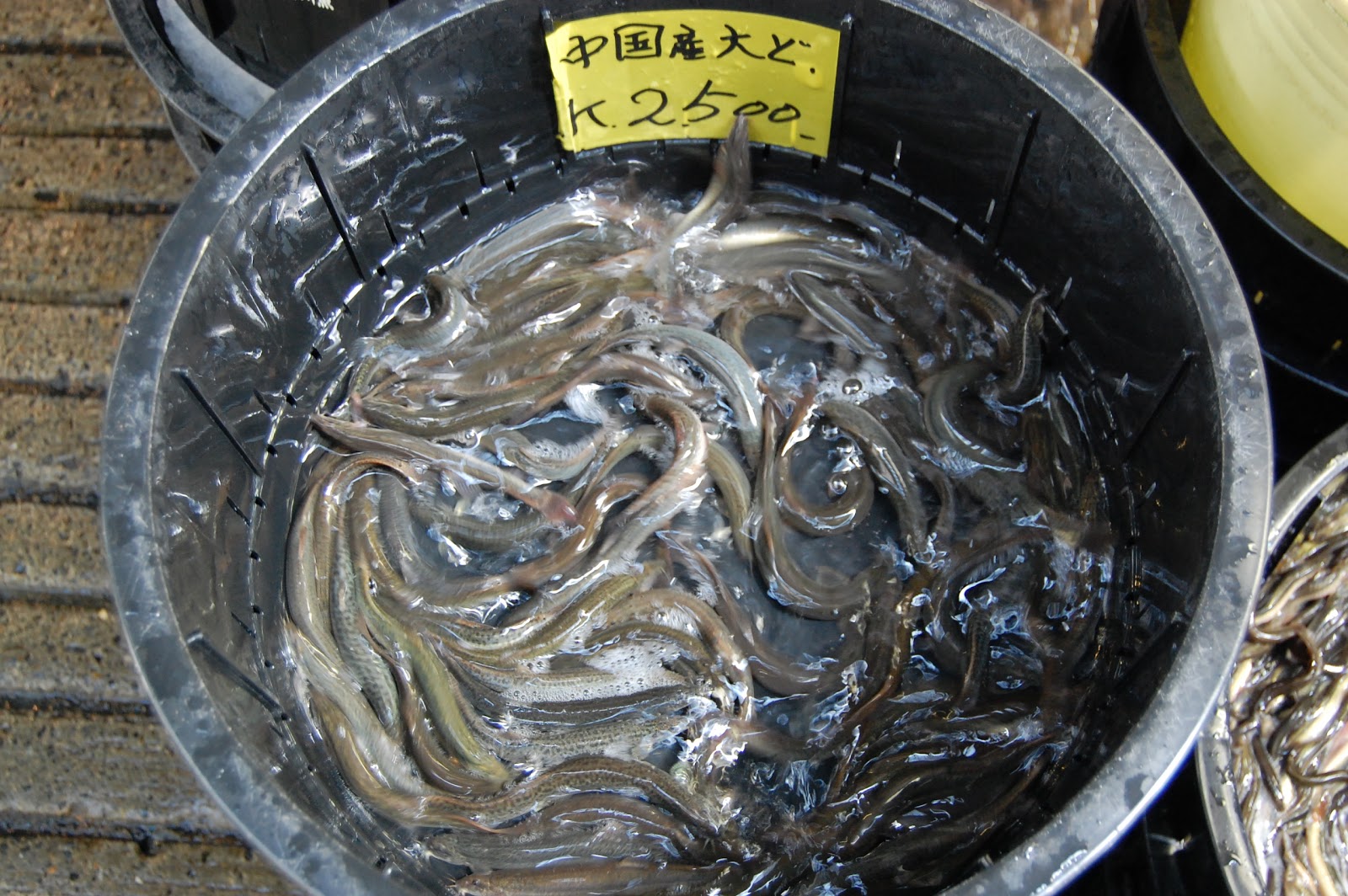


There's nothing better than a bucket of eels, is there?


"One day I'm gonna get me an R2D2 unit like Haruki's."


Three men, an ancient looking cart, and a ready-made photo opportunity.


"Mom, which knife should I use to disembowel the nosey Englishman?"


Don't you just hate it when a prawn burrows into your neck?


"Aren't you glad you're not us?"


If you don't want to know what they did with this blood-soaked chopping board, razor-sharp knife and bit of bent coat hanger, don't look below.


It's a cruel world ain't it?

Saturday, 30 October 2010

Gordon Ramsay (in Dubai) - The C-word


No, it's not that C-word, in case you were wondering. But neither is it 'cooking', 'cuisine' or 'caramelised sugar'. It's cars, of course. Because what else would Gordon Ramsay do on his first visit to his Dubai restaurant in two years but screech around the local race-track in a fast sports car? 


The restaurateur, star of The F Word, Hell's Kitchen and Kitchen Nightmares, ex-Glasgow Rangers trialist and occasional cook was in the UAE for a mere 24-hours, in which time he managed to fend off the press, gee up his staff and launch his chef's table concept at Verre by Gordon Ramsay. As a special surprise for Gordon, his team had arranged for him to spend the afternoon driving fast Audis (Audi happens to be one of Ramsay's sponsorship partners, so that was a stroke of luck). "Driving a fast car around a track is a chef's dream," he told me. 


After interviews at the restaurant, esteemed members of Dubai's press, and me, were whisked off to the Autodrome to watch Ramsay go through his paces on the track. I had the dubious honour of accompanying Ramsay in his car as he did his time trial, which obviously gave him a weight advantage. The above video shows what happened...


Thursday, 24 June 2010

Who put the boot into Bhutanese food?


The cuisine of Bhutan was once famously given a right kicking by the ex-New York Times restaurant critic and Gourmet magazine editor Ruth Reichl. She called it the world's worst. So when I recently visited the Land of the Thunder Dragon - the mysterious 'last shangri la' Kingdom hidden in the eastern Himalayas - I was intrigued as to whether the food could actually be as bad as all that. I mean, had Reichl ever eaten Welsh lava bread, Filipino balut eggs (replete with feathery duck embryos) or American plastic cheese by Kraft? 


Above is the first restaurant I set foot in - in the town of Paro, not far from Bhutan's only international airport. Colourful, isn't it? It's got everything a cheerful tourist restaurant might need - bright colours, sturdy wooden tables and chairs, nicely folded napkins, some pretty flowers...

  
...  and a load of car steering wheels stuck on the ceiling. Obviously. They might not be big in the west yet, but steering wheel ceilings are all the rage in the Himalayas. Then I had to wonder whether this was some kind of symbol, a private Bhutanese joke, if you like, about the food served up to whiny foreigners (like Ruth Reichl), and the bend that the locals enjoy driving clueless tourists around with their insipid grub.


Then the food arrived. I must confess, it didn't look like the most inspiring spread I'd ever seen. There was loads of it, but my guide, Tshering, refused to join me in a mouthful. "You first," is what I wanted to say, because if I was going down I at least wanted to take him with me. He grimaced a bit and had a spoonful of plain boiled rice. There was a Chinese-style beef dish, which was as tough as a yak's wellingtons, some plain boiled cauliflower, a dahl soup, and some more Chinese style vegetables. 

I asked him where the ema datshi was, the famous national dish of cheese and red chilli. He explained that it was too hot and spicy for tourists. Since independent travel is forbidden in Bhutan, my guide had worked out my entire itinerary, including the food I was going to eat. I told him to inform the waiters to get busy with the chillies, and in no time a bowl of the famous ema datshi materialised. "You like it," enquired Tshering, with a smirk? "Yhhessss..." I rasped, as my eyes welled up and I reached for the water. Tshering just grinned, and I sensed a steering wheel gently turning overhead. 


Although he seemed pleased that I'd tried to immerse myself in Bhutan's fascinating food culture, I suspected Tshering wanted to punish me in some way for my impudence. I can think of no other reason why, while touring the next day, he asked our driver Jigme to pull over at this roadside stall. Those apples look good, I thought, but Tshering made a beeline for this...


It was dried yak's cheese, merrily hardening in the morning sun. When he handed me a block I thought it was some kind of resilient classroom chalk, or perhaps something used to remove dead skin in the bath. 

  
As this image illustrates, it was indeed hard cheese. The thing had to be bludgeoned heavily with a rock in order to break it up into mouth-sized pieces. "Here, chew it," said Tshering as he lumped a piece into his mouth and began chomping away.

Gah, wouldn't you know it - I'd left my titanium-plated dentures at home. It was like catching a plastic bullet in the mouth. Personally, I didn't know whether to eat it or shoot Maoist insurgents with it. Try as I might, my old fashioned human calcium and enamel teeth could not penetrate the granite-like snack. And since I quite liked having my molars intact (call me soft, but I sometimes like to chew food before I swallow it) I decided to suck the yak's cheese instead, to see if it'd soften up. Half an hour later I spat it out the car window, fully intact, while Tshering wasn't looking.  I think it ricocheted off a rock and killed a peasant.


Lunch that day was far more palatable. It began with a spot of tea - butter tea to be exact (po cha to call it by its local name). It was a curiously savoury drink of warm tea mixed with yak's butter and salt. Quite good, in fact, and just the thing on those cold winter nights several thousand metres above sea level in the Himalayas. Apparently the butter provides sufficient calories for working at such high altitudes, and helps prevent chapped lips in the biting wind. Not all cups of butter tea come with a ghostly apparition of a man's face floating above it - that's a reflection of Choki, founder of the Blue Poppy tour company - Tshering's boss.


Today's lunch selection - in a restaurant in the capital city of Thimphu - was much better. As well as a lip-swellingly hot bowl of ema datshi creamy cheese and red chilli, there was white rice with maize, red rice (which grows at high altitudes), fatty pork and boiled radish or phagsha pa, norsha fin or beef with rice noodles, potato with cheese or keaa datshi, and egg with cheese or eggy cheese. I got stuck in.


So did Choki. Some years ago, he married an English woman. He told me that on his first visit to England, he couldn't get out of the London underground station as he'd never even seen an escalator before, let alone used one. Bhutan only recently got its first mobile phones and satellite TVs.  The capital city Thimphu has no traffic lights.


A few days later, back in Paro, Tshering (above) took me to a farmer's house for lunch. The owner, also called Tshering, said the place was 3-400 years old. It has been owned by his wife's family all that time, but these days it's open for tourist lunches. They even have a couple of rooms available.


Lunch was a simple but surprisingly tasty affair. There was weapons grade ema datshi, beef, potatoes, white rice and asparagus sauteed in butter.


As I ate with a wooden spoon, Tshering translated the farmer's tales of 'night hunting' when he was a teenage lad. This didn't involve shooting yaks after sundown, but climbing up the runged windows of farm houses to look for young girls. If there was one inside, he would hop in and get saucy - all while the parents 'slept' in the same room.


He even showed me the worn rung on the window, used for over three hundred years of the bizarre and very Bhutanese courting ritual of night hunting.


There he is, now a humble farmer and a capable cook, but once a night hunter. I could tell he was getting nostalgic and starry eyed while he was talking about his teenage exploits. But I never expected this...

 
He grabbed a handful of leftover boiled rice and began nimbly fashioning a strange object in his hands. He seemed very adept at making his model, squeezing and folding. Looked like he'd had plenty of practice...


And then this. Yep, it is what you think it is. A little on the modest side, I'll grant you that, but still not a bad representation of a Bhutanese John Henry Thomas. Needless to stay at this stage, it looked a little less likely that I'd take the room.


I thought perhaps the above bottle of Jack and the half empty bottle of Chivas Regal might have had something to do with Farmer Tshering's impromptu handicraft session, but no. Apparently the phallus is a good luck symbol offered to travellers. I said I needed a bit of luck, as my football team Aston Villa were playing Chelsea later that night. 


We got shafted 7-1.


Like the food in Bhutan, my luck in this fascinating Himalayan Kingdom was hit and miss.

Wednesday, 9 June 2010

Pot Noodle World Cup - part 3


Lucky Me - Bulalo
Philippines
(sachets - 3 + plastic fork)


As if to remind you that Filipino food is a bit, well, crackers, there’s a sachet of crackers included with this nest of noodles. You also get sachets of ‘beef’ soya bits and an indeterminate variety of flavouring powder, which, when everything comes together, re-creates the Filipino classic Bulalo - kind of. Everybody knows that crackers and soup go together like rump steak and chewing gum, and what any good bulalo really needs is a huge bone or two, stuffed with soft, juicy marrow. Taking the bone out of bulalo is like removing the karaoke machine from a Filipino funeral wake - leaving the whole thing flat, disappointing and as lifeless as the chick in a balut egg.

4/10 - Potty.


Koka - Laksa
Singapore
(sachets - 4 + plastic fork)


Having a pot noodle in your cupboard is like having a spree-killer your family - you’d prefer not to admit it at dinner parties. But when a minor lunchtime crisis strikes - or some kind of nuclear conflict happens - you could do much worse than this. There’s everything you need here to survive armageddon for at least a couple of hours - from the 4 sachets (seasoning, chilli oil, dried veg and coconut powder, in case you were wondering) you can use the plastic to fashion some kind of radiation-proof hat; and the pleasant, creamy and soupy noodles will keep you occupied for at least 12 minutes prior to that. In peacetime however, it’ll just make you long for real laksa, and leave you feeling slightly empty inside. 

6.5/10 - Laksa little something. Ha-har - I’m here all week, folks!


Nissin
Japan
(sachets - 2)


You know what they say about the Japanese - the Pot Noodles they eat today are the Pot Noodles the rest of the world will be eating in 2078. Discovering this impressive melange of futuristic ingredients is like a trip in a DeLorean fixed with a flux capacitor. The plastic lid snaps off to reveal a sachet-fetishist’s wildest dream. Even the noodles come in a sachet, and guess what - they’re wet. Where most noodle-cakes resemble a tramp’s urinal-dampened shoelaces dried out on a radiator, these are moist, thick, bouncy udon noodles. There’s a sachet of miso-style powder with dried seaweed bits and then the coup de grace that buries all other pot noodles in a kettle-shaped coffin marked “fail” - a sachet containing a whole, flat, dried tempura cake, packed with fishy flavourings and prawn bits. By the time the rest of the world are eating these noodles, the Japanese will have done away with food altogether and replaced it with sound waves or dehydrated trousers.  

12/10 - Pot of gold.


Pot Noodle World Cup winners 2010 - Japan

Monday, 7 June 2010

Pot Noodle World Cup - part 2


Samyang - 60 Ingredients
South Korea
(sachets - 1)


The Koreans got special dispensation to have two entrants in the 2010 Pot Noodle World Cup, largely because it’s a fictional competition. As such, Samyang’s ’60 ingredient’ flavour variety surprises with its sheer amount of ingredients. The packaging shows broccoli, onion, sesame powder, a carrot, mushroom, garlic, leek, paprika, radish, pak choi, oats (WTF?), chilli powder and a pollack - but that’s just thirteen ingredients. In fact, I’m having trouble just thinking of another 47 ingredients off the top of my head. And because the only other English words on the packaging are ‘MSG’ and ‘well-being’, for or all I know there could be roasted armadillo, prune ice cream, parrots' feathers and bee spit in there. Whatever it is, tastes pretty good.

7/10 - Hot noodle.


Pot Noodle - Doner Kebab
England
(sachets - 1 ‘chilli soss, my friend’)


The English have had doner kebab grease (and weak lager) running through their veins for centuries, so this pretty little pot had me roaring ‘God Save The Queen’ - out of tune and with the wrong words - until my thyroid went wonky. I was revived, briefly, by the comely aroma, but I’m afraid the words ‘soya pieces‘ and ‘doner kebab’ should never occupy the same packaging. It’s either the eyelids, testicles, lips and chest-warts of a 39-year-old sheep with scrapie, and a bit of cat, or nothing at all, OK Stavros?

4/10 - Gruel Britannia.